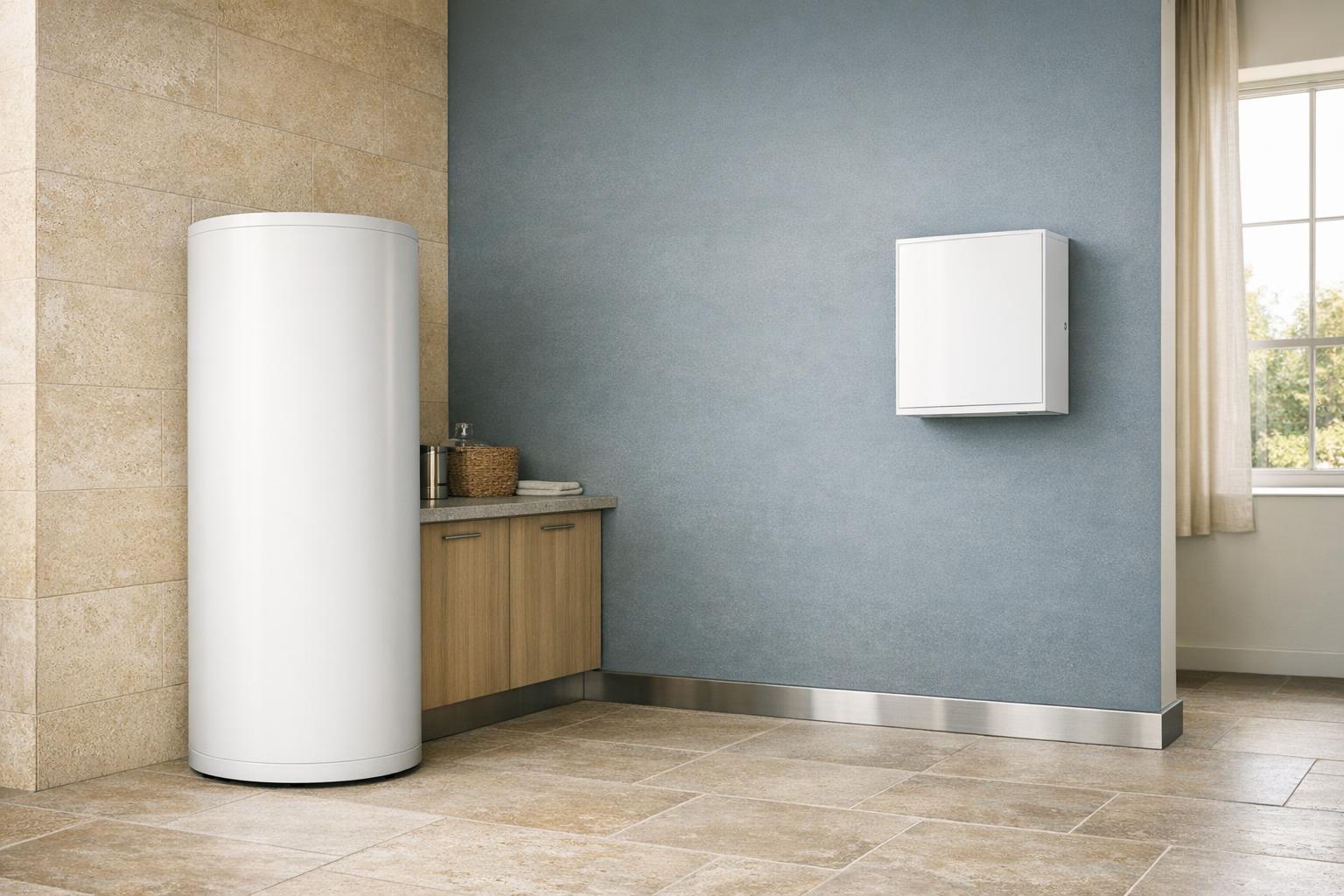
A tank water heater keeps a reservoir of hot water ready; a tankless heater warms water only while a tap is open. That single design difference changes how hot water runs out, how much energy is lost while nothing is running, how long the equipment is expected to last and how much work the installation involves. This guide compares the two on those points using a U.S. Department of Energy-funded building guide and manufacturer documentation, so you can decide which questions matter for your home before you compare models.
Tankless or tank: the short answer
Short answer A tankless water heater is usually the better fit when you want continuous hot water, lower standby losses and a longer service life, and you can afford a higher installed cost. A tank water heater is usually the simpler, cheaper replacement when your existing gas line, venting or electrical service would need major upgrades for a tankless unit.
The Pacific Northwest National Laboratory guide written for the DOE Building America program summarizes the trade-off plainly: the initial installed cost of a tankless heater can be 1½–2 times that of a tank-type heater, while the tankless unit costs less to operate each year. Neither type is automatically right; the deciding factors are your simultaneous hot-water demand, your fuel, and what your home can supply.
- Choose tankless when: long showers or back-to-back draws regularly empty your tank, and you have room in the budget for gas-line, venting or electrical work.
- Choose a tank when: a like-for-like replacement keeps the existing fuel supply and vent, and the upfront cost matters more than long-run efficiency.
- Either way: size by simultaneous flow and temperature rise, and have a licensed installer confirm what the home can support.
How each type delivers hot water
A conventional tank stores hot water, typically 20–80 gallons according to the PNNL guide. That stored volume lets a household use a lot of hot water quickly, but after a large draw the burner has to reheat the tank, and the guide notes that hot water may not be available again for 20–30 minutes or more in many systems.
A tankless heater has no reservoir to run out of, so its limit is different: the flow rate. The DOE Energy Saver page says these units typically provide hot water at 2–5 gallons per minute, with gas-fired models producing higher flow rates than electric ones, and A. O. Smith notes that electric tankless models provide less hot water than gas tankless models. If several fixtures open at once and the combined flow exceeds what the unit can heat at your temperature rise, the water arrives cooler. That is why our sizing guide and flow-rate calculator start from simultaneous fixtures, not from bedroom count.
There is also a lower limit worth checking. PNNL points out that hand washing or dish rinsing often uses less than 0.5 gpm and that not every tankless model can deliver such low flows; the minimum activation flow is listed in the manufacturer literature.
| Question | Tank (storage) heater | Tankless heater |
|---|---|---|
| How hot water is supplied | Stored reservoir, typically 20–80 gallons | Heated on demand while water flows |
| What runs out | Stored volume; reheat can take 20–30 minutes or more after a large draw | Nothing runs out, but flow above the rated capacity arrives cooler |
| Typical delivery figure | First-hour rating | About 2–5 gpm at a given temperature rise |
| Standby heat loss | Yes, the tank loses heat while idle | Avoided, because no water is stored |
| Expected service life (PNNL) | 10–15 years | Up to 20 years |
| Installed cost (PNNL) | Baseline | Can be 1½–2 times a tank-type heater |
Efficiency and operating cost
The efficiency gap comes mostly from standby losses. PNNL reports that tankless heaters can cut energy costs by 5%–40% compared with a tank-type heater using the same fuel, and gives typical energy factors of 0.57–0.70 for gas-fired tank heaters versus 0.82–0.94 for gas-fired tankless units, depending on whether the tankless unit is condensing. Our condensing guide explains that label.
Current labels use the Uniform Energy Factor (UEF). A. O. Smith reproduces the DOE usage bins: a UEF can only be compared with models in the same bin, and tankless bins are set by maximum gpm. A higher UEF does not always mean the lowest bill when the fuels differ, so compare like with like and use your local gas or electricity price.
| Bin | Daily usage (gallons) | Tank: first-hour rating | Tankless: max gpm |
|---|---|---|---|
| Very small | 10 | Less than 18 gallons | Less than 1.7 |
| Low | 38 | 18 to 51 gallons | 1.7 to 2.8 |
| Medium | 55 | 51 to 75 gallons | 2.8 to 4 |
| High | 84 | 75 gallons or larger | 4 or more |
Electric tankless units deserve a separate note. PNNL warns that because they heat instantaneously they can create high peak electrical loads, which can be expensive where utilities charge more at peak times. Our gas-versus-electric guide covers that comparison in detail.
Installation work that changes the answer
Most of the cost difference is installation, not the box. For gas units, PNNL notes that tankless burners are much larger: its example is a tankless heater that might require 199,900 BTU against about 40,000 BTU for a typical tank heater, so the home may need a ¾-inch line where a ½-inch line served the tank. Replacing a tank usually means a new vent pipe as well, and a condensing unit needs a condensate drain.
Electric tankless heaters skip venting but draw much more current. A. O. Smith lists 51 amps at 240 volts for a 12.2 kW unit and up to 133 amps for a 32 kW unit, and notes that electric tankless heaters draw more amps than electric tank-style heaters. Whether your panel and service can carry that is a question for a licensed electrician; our electrical-requirements guide lists the documents to bring.
- Gas line: confirm the supply can feed the tankless input plus every other gas appliance at the same time.
- Venting: expect a dedicated vent, often through a sidewall; an old shared chimney flue may need a draft check.
- Condensate: condensing units need a drain route and, PNNL recommends, a neutralizer.
- Electrical: whole-house electric units can require multiple large breakers and service capacity.
The installation overview explains how to request a quote that itemizes these trades.
Lifespan and maintenance
Service life is one of the strongest arguments for tankless. PNNL states that tankless heaters are generally considered to last up to 20 years, compared with 10–15 years for tank-type heaters. That longevity is conditional on care: in hard-water areas scale builds up in the heat exchanger, reducing capacity and efficiency, and PNNL notes that many manufacturers recommend professional yearly cleaning, made easier by isolation valves fitted at installation.
Warranty terms point the same way. Rinnai’s SENSEI residential warranty, for example, covers the heat exchanger for 15 years or 12,000 operation hours, other parts for 5 years and reasonable labor for 1 year, and excludes damage from scale build-up or freezing. See how long a tankless water heater lasts and the maintenance guide for the ownership side.
Which homes suit each type
Use the comparison as a filter rather than a verdict. These patterns follow directly from the sourced points above:
- Busy households with long showers: tankless removes the reheat wait, provided the unit is sized for the fixtures that run together.
- Small households with modest daily use: the efficiency gain over a tank is real, but the higher installed cost takes longer to recover.
- Homes with a ½-inch gas line and a shared chimney: a tank replacement may avoid gas-line and venting work; price both options.
- All-electric homes: compare whole-house electric tankless against panel capacity, and consider the peak-load point PNNL raises.
If tankless survives that filter, our comparisons of indoor natural gas tankless heaters, outdoor propane units and whole-house electric models list the documented flow, input and power figures for each listing. For the money side, read our breakdown of tankless installation cost drivers.
Sources and further reading
- PNNL Building America Solution Center: Gas-Fired Tankless Water Heaters (U.S. DOE-funded guide)
- U.S. DOE Energy Saver: Tankless or Demand-Type Water Heaters (archived June 30, 2026)
- A. O. Smith: Tankless Water Heater Installation Guide (manufacturer information center)
- Rinnai America: SENSEI Residential tankless water heater limited warranty (PDF)