Rinnai RU199iN Condensing
9.1Excellent · out of 10Best for: a busy house where two showers and the dishwasher overlap
- Stated maximum flow: 11 GPM
- Condensing design stated in the title
The catch: Expect less than 11 GPM when the groundwater is cold.

Updated October 2026 · 5 heaters, no paid placements
Five condensing gas units: the kind with a second heat exchanger that pulls heat out of the exhaust before it leaves the house. If you're swapping an old tank and want the efficient option, this is the shortlist we'd start from. Ranked on buyer ratings, review volume and what each listing states.
See the ranking
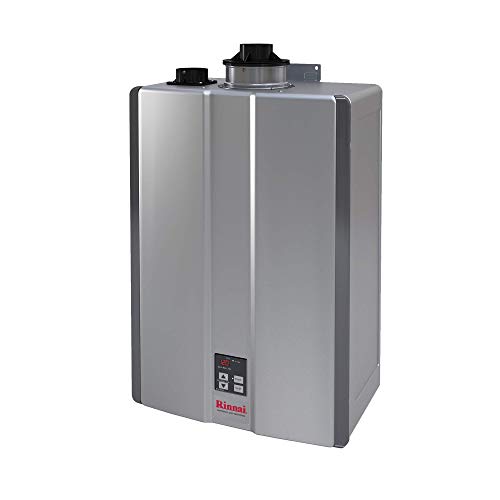
Our top pickRinnai RU199iN Condensing9.1/10. The one we'd start with.See current price
The crowd favouriteRinnai RX160iN Condensing Smart Sense70 buyer reviews, 6.8/10. Plenty of owners to learn from.$1,442.70 on Sep 30, 2026, may have changed
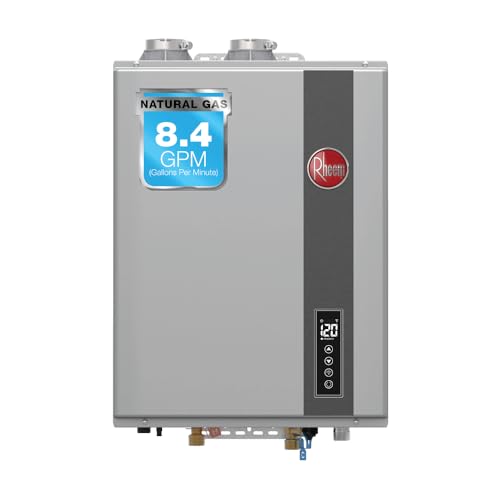
The best stated UEFRheem RTGH 8.4 GPM Natural Gas IndoorUEF 0.93 per the listing, 7.3/10. The biggest figure among the rest.$1,168.99 on Sep 30, 2026, may have changedWant the efficient one without reading five spec sheets? Start with the Rinnai RU199iN Condensing. The other four differ on flow, burner size and what the box costs before the vent pipe and the condensate drain. Variants of one listing share a slot, so these are five different condensing heaters, not one heater in five sizes.
Written from each listing's specs and buyer reviews, not from our own use · How we rate

Best for: a busy house where two showers and the dishwasher overlap
The catch: Expect less than 11 GPM when the groundwater is cold.

Also available as: RTGH 9.0 GPM Natural Gas Indoor (9 GPM)
Best for: a two-bathroom house with one shower running at a time
The catch: 60 buyer reviews is still a thin record; the average can shift.

Also available as: RX130iN Condensing Smart Sense (7.1 GPM) · RXP160iN Condensing Smart Sense (9 GPM)
Best for: a family that showers back to back before school
The catch: Venting and a gas line sized for its input come on top of the price.

Best for: replacing a 40-gallon tank in a mid-size home
The catch: Condensing means a condensate drain, and usually a neutralizer.

Best for: swapping a 50-gallon tank for a house with three bathrooms
The catch: Its 3.3/5 buyer rating is the lowest of these five.
Product images: Amazon listings
The best-rated unit for each band of maximum flow its listing states. Count the showers that run together on a busy morning, then read across (and keep in mind that the listing figure is a mild-weather one).
| 6 to 8.9 GPM | Rheem RTGH 8.4 GPM Natural Gas Indoor (#2) · 7.3/10 · 8.4 GPM |
|---|---|
| 9 GPM or more | Rinnai RU199iN Condensing (#1) · 9.1/10 · 11 GPM |
Plenty of gas tankless listings put "high efficiency" in the title, non-condensing ones included. We only let a heater in here when its listing title states a condensing design, because that's the part that actually changes the efficiency (and the install). Ten listings with a buyer review record pass that bar, from seven listing families. Where a listing states its Uniform Energy Factor, the figures run from 0.93 to 0.97. For scale, the PNNL guide written for the DOE Building America program gives energy factors of 0.82 to 0.94 for gas tankless units and 0.57 to 0.70 for gas tank heaters.
Honestly, the catch is the install. A condensing unit vents through PVC or stainless pipe and makes slightly acidic condensate, which has to drain somewhere, ideally through a neutralizer (PNNL recommends one). If your old tank sits mid-basement with a metal flue up the chimney, price that work before you fall for a UEF. The condensing vs non-condensing guide weighs the trade, the gas tankless ranking has the non-condensing alternatives, and the condensate neutralizer kits we rate sit in the parts collection.
All 5 on one screen. Tap a column header to sort by what matters at 6:45 on a weekday: flow, power or price.
| Rinnai | 9.1 | See current price | Natural gas | 11 GPM | Not stated | Not stated | Indoor, condensing | 388 | |
| Rheem | 7.3 | $1,168.99† | Natural gas | 8.4 GPM | 157,000 BTU/h | Not stated | Indoor, condensing | 60 | |
| Rinnai | 6.8 | $1,442.70† | Natural gas | 9 GPM | Not stated | Not stated | Indoor, condensing | 70 | |
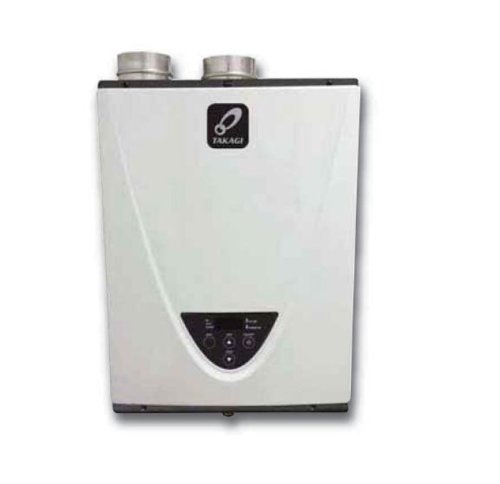
| Takagi | 4.5 | See current price | Natural gas | 8 GPM | Not stated | Not stated | Indoor, condensing | 25 | |
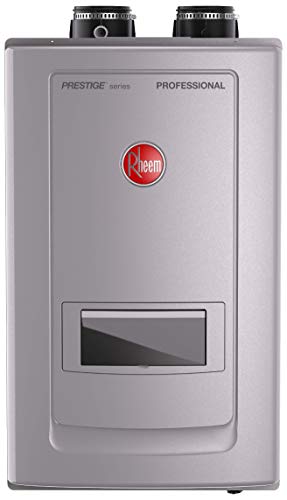
| Rheem | 4.4 | $1,199.99† | Natural gas | 11 GPM | Not stated | Not stated | Indoor, condensing | 27 |
† Prices as of Sep 30, 2026; they may have changed. The button always shows today's price.
Every heater gets a score out of 10 from its exact listing. We look at what buyers give it, how many of them there are, and how completely the seller documents the specs and the warranty, then at how it stacks up against the other heaters in the list. On an exact tie, the listing slug settles the order.
We haven't installed or run these heaters ourselves, and a commission never moves a rating or a rank.
Our pick is the Rinnai RU199iN Condensing, at 9.1/10 (excellent). It has 388 buyer reviews averaging 4.4/5, and its listing states 11 GPM. Next in line: the Rheem RTGH 8.4 GPM Natural Gas Indoor at 7.3/10.
We start from 10 complete gas tankless units whose exact listing title states a condensing design, each with a buyer review record. Each one gets a rating out of 10: 45 % buyer rating, 35 % review volume and 20 % how completely the listing documents its specs. Variants of one listing family (same parent listing) share a single slot, so you see 5 different heaters rather than one heater in 5 sizes.
It depends on how much hot water you use and what the install costs in your house. A condensing unit sends less heat up the vent, which pays back fastest in a busy household; it also needs a condensate drain and its own vent run, which can eat the saving in a small one. Ask for two written quotes for the same flow, one condensing and one non-condensing, and compare them line by line.
Five of the ten eligible listings state a Uniform Energy Factor, from 0.93 to 0.97. The others don't print one in the listing, so we don't guess. Compare a UEF only with models in the same usage bin (the bins are set by maximum GPM, as our tankless vs tank guide explains).
They vent differently from a tank. The PNNL guide notes that high-efficiency units use PVC or stainless steel vent pipe, and that the slightly acidic condensate has to be drained per local code, with a neutralizer recommended. A licensed installer sets the route from the exact manual; we give no venting instructions.
Among the 8 eligible condensing listings with a price we recorded, the box alone ran from $499 (Vancepic Condensing Natural Gas Indoor) to $1,685.60 (Rinnai RXP160iN Condensing Smart Sense), with a median of $1,242.10, on Sep 30, 2026. Prices move, and the installer's bill comes on top, including the vent and the condensate drain.
Each price is the one we recorded on Sep 30, 2026, and it may have changed since. The button always opens the exact listing with today's price and seller.
No, we haven't installed them in a house of our own. The ratings come from what buyers say and from the specs stated in each exact listing, weighed with a formula we publish.